Saved by the Whales?
I left Olympia just as Washington state was staring down an unprecedented heatwave. I’m going to visit my sister Angela and her family in southern California. This is my first post-vaccination trip anywhere, and the first time I’ve seen them in a year and a half. Philip, my 14-year-old, gets to come with me because he too is vaccinated. My 11-year-old daughter has to stay home with my husband because she is not. Yeah, I know. Pandemics aren’t fair.
I need this trip. I need just a little bit of normalcy. And a little bit of hope. When Angela invited us to go whale watching this week, I hesitated. My climate despair, always strong, is particularly intense right now. Ecotourism seems unlikely to be the ray of hope I’m looking for. I don’t even really know what’s going on with whales, but it can’t be good, right? Still, I have the boy with me, and we could really use some opportunities to round out his distance learning experience of the last year. So whale watching it is.
We caravan to Dana Point: The Whale Capital of the World. There’s also a Denny’s, Philip points out. There are several boat trips loading this morning, and with the lines spaced to maintain social distancing, we can’t tell them apart. There seems to be a good chance that we will get on the wrong boat, but we are excited anyway. The smallest of the children in our group each get a coupon for a free popsicle. Philip is proud that he’s too old to be offered such treats by passing strangers, but still a little disappointed about the popsicle. I distract him by pointing out pelicans, seagulls, ducks, pigeons.
We board the correct boat and meet Nona, a naturalist with sun-bleached hair and skin. She walks calmly and steadfastly upright on this boat that is moving so much it nearly threw me off the stairs. It’s cloudy, she points out, but our visibility is pretty good. It’s everyone’s job to look for whales, she says. We’ll need to study the horizon, looking for water spouts. The captain comes over the loudspeaker. He warns us that they can’t guarantee that we will see a whale, but they are in contact with other boats. If there is a whale within ten miles of this ship, we’ll hear about it. In fact, he adds, the fishing boats are reporting that they have seen blue whales, but further out than the ten mile radius we’ll be able to reach.
The boat rocks up and down. The kids have stomachs of steel. I find that I can take notes and take photos, but if I look down to read my notes or check out the photos, I am instantly nauseated. Instagram will have to wait.
A pod of common dolphins joins us off the side of boat. I notice the birds first. They are fishing for the same anchovies and bait fish that our new dolphin friends are. The dolphins bring the fish up to the surface, eat, and the birds get the ones the dolphins don’t. The captain reminds us over the loudspeaker—when you see a dolphin, you have seen a whale! Dolphins are a kind of toothed whale, different than the giant filter feeders we’re looking for. They swim underwater and come up for air and to play with us, leaping acrobatically out of the water. The captain says, “One question I often get is could the boat run into the dolphins. And the answer is no.” And not just because the captain is trying to miss them—the dolphins are using their echolocation to make sure they don’t run into us.
The dolphins can get up to 275 pounds. The males tend to be larger than the females. It’s good living here for dolphins. They are called “common dolphins” because they are so populous. There is plenty of food, and the dolphins don’t migrate either to eat or to have their babies. “Common” or not, we are awestruck. Philip declares this trip, educational though it may be, “so worth it!”
I try to adjust my eyes to notice the life under the water. I’m confused by the light and dark playing on the water as it moves. There are lots of dolphins here, but I really only see them when they leap out of the water. Most of the light I see glinting off the swells is just light, not dolphins.
The captain comes over the loudspeaker: “Get your photos now and say goodbye to this pod of dolphins. There’s a chance we might see a whale on this trip. I just heard of one, but it’s pretty far out.” The boat picks up speed, getting a little rollercoastery as it bounces on the waves. “If you look behind us,” the captain says, “the dolphins are surfing in our wake.” Sure enough—the dolphins appear to be living their best lives playing in the California surf.
I’m studying the water. I see boats, water, birds, ocean spray. Wait. Is that spray from a whale or just, you know, rocks? I feel the boat change direction, heading right towards what I thought I saw. I don’t know what the captain sees of us, but he seems to read my mind. “You see it, don’t you?” he says over the loudspeaker. He lets us know that the whale went under the water at 11:04. The other boats have let the captain know this whale tends to stay underwater for 7-9 minutes at a time. The captain tells us that’s not very long for a blue whale. It wouldn’t be unusual to wait 12 minutes to see a whale come to the surface again. But—this time the captain has seen his tail. This lets him know it is likely that the whale will stay submerged for a bit longer.
We won’t see a pod of blue whales like the dolphin pod we saw. The blue whale is most often seen alone or in a pair. Which is romantic, right? Fitting for a creature with a 1000-pound heart. The captain is going to move so that the whale is on the boat’s left. We all move to the left side of the boat. I have a great spot. I have COVID to thank for my vantage point—On a non-pandemic day, there would be twice as many people. As it is, I lean over the side and feel the ocean spray on my face.
In 11 minutes, the whale surfaces. We see her back arching out of the water. Not high and tight like the dolphins—a long, slow arch. Blue whale females are bigger than the males, reaching about 150 tons. The males are about 100 tons. This is bigger than, well, everything. The blue whale is bigger than every dinosaur that’s been discovered so far. Partly this is because it lives in the ocean, unencumbered by gravity, which limits the size of landlubbers to a size their bones can support.
You know what all those tons of flesh are? Carbon. (Well, krill, if you are of the “you are what you eat” school of thought.) All living beings are carbon sinks. The bigger the body and the longer the life, the more carbon that is kept out of the atmosphere. A blue whale lives for 80-90 years and captures as much carbon as a thousand trees.
And then, when the whale dies, all that carbon sinks down to the ocean floor. If you imagine an elephant (not nearly as big as a whale, but big) who dies in the forest, as she decomposes, her carbon is gradually released back into the atmosphere. The blue whale takes her carbon with her to the bottom of the sea, where, largely, it stays and nourishes the sea floor and marine ecosystems.
We see a spurt of spray come out of the blow hole as the whale retreats once again. As she dives we see just a glimpse of her iconic tail fin. We settle in to wait the 7-11 minutes before she comes back up to the surface. She might be looking for food. She has to find four tons of krill today. She’ll look for a swarm of the tiny shrimp and take the whole swarm into her giant mouth. Closing her mouth, the water will return to the sea through the baleen filter of her mouth, and the krill will stay.
“The whale is right underneath the boat right now!” the captain announces. I start to look around for the life jackets I dutifully noted as we boarded. Someone has apparently voiced a similar concern to the captain because he’s immediately back on the loudspeaker, almost mid sentence. “No, no—it’s 600 feet down! Nowhere near the boat—I can see it on our fish monitor.”
Part of the role the whale plays in the ocean ecosystem is taking nutrients from the deep and bringing them up to the surface in the form of giant, buoyant whale poops. These huge poops supply iron and nitrogen to blooms of tiny algae called phytoplankton. Phytoplankton, like all plants, are fabulous carbon capturers. They are tiny, but their power comes from their sheer numbers. Phytoplankton supply half of the world’s oxygen and capture about 40% of all the carbon dioxide we produce. This is equivalent to 1.7 trillion trees. More phytoplankton means more carbon capture. And more whales means more phytoplankton.
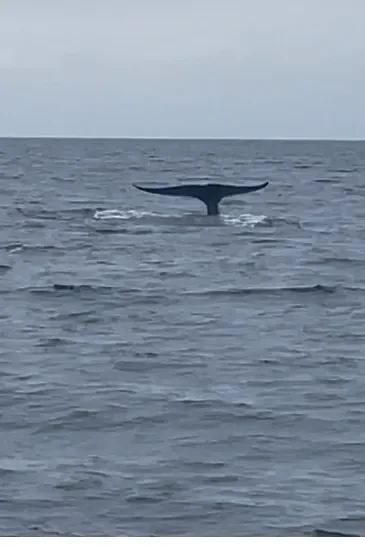
“You guys aren't looking very hard!” the captain chides. I am. I’m looking very hard, but, in fact, I do not see the whale until the captain turns the boat. We see the spray again, and the whale's body starts to move gracefully under the water. And then we see it—that big tail fin raised high in the air like a flag. We cheer and applaud and wonder if we got a photo of that. Even the captain is excited—“Yes!” He shouts. “That’s the money shot!”
All business again, the captain tells us to say goodbye to our whale friend. Our two-hour tour is over. As we motor back to shore, we learn that we are now part of a select group of just 1% of people on earth who have seen a blue whale up close. The naturalist offers us one percenter buttons, and before I realize she’s talking to the children, I put my hand out over their heads and say, “Yes, please!”
Seeing a blue whale in person has to do with geography and opportunity to be out in the water, but another reason there are so few people today who have seen one might be that the blue whale population is now just 3% of its previous population. Like many carbon sinks, whales make good fuel. One blue whale could get you 120 barrels of the cleanest burning oil known at the time. And they were hunted nearly to extinction until a 1966 law prohibited it. The whale populations are growing again. And this is good news. It’s a glimmer of the hope I’m looking for.
Or if not hope, a slight buckling of my climate despair. Could it be that traditional environmentalism of the “save the whales” sort can make a real impact in preventing the worst disasters of climate change? As the whales remove many forest worths of carbon from the air and nourish blooms of phytoplankton that take even more carbon out of the air, could we, to some extent, be saved by the whales?
Back home, it’s hotter than it’s ever been. Ever. My email brings news of a well-known community member who has died of heat exhaustion. I post my photo of the whale’s tail—the “money shot”—on Instagram. I want to tell social media that these whales might be a key to helping us reduce some greenhouse gasses, but even this small glimmer of hope rings a bit hollow to me in the midst of a deadly heat wave brought on by the climate crisis. Instead I caption my photo: “You guys! I saw a whale!”